
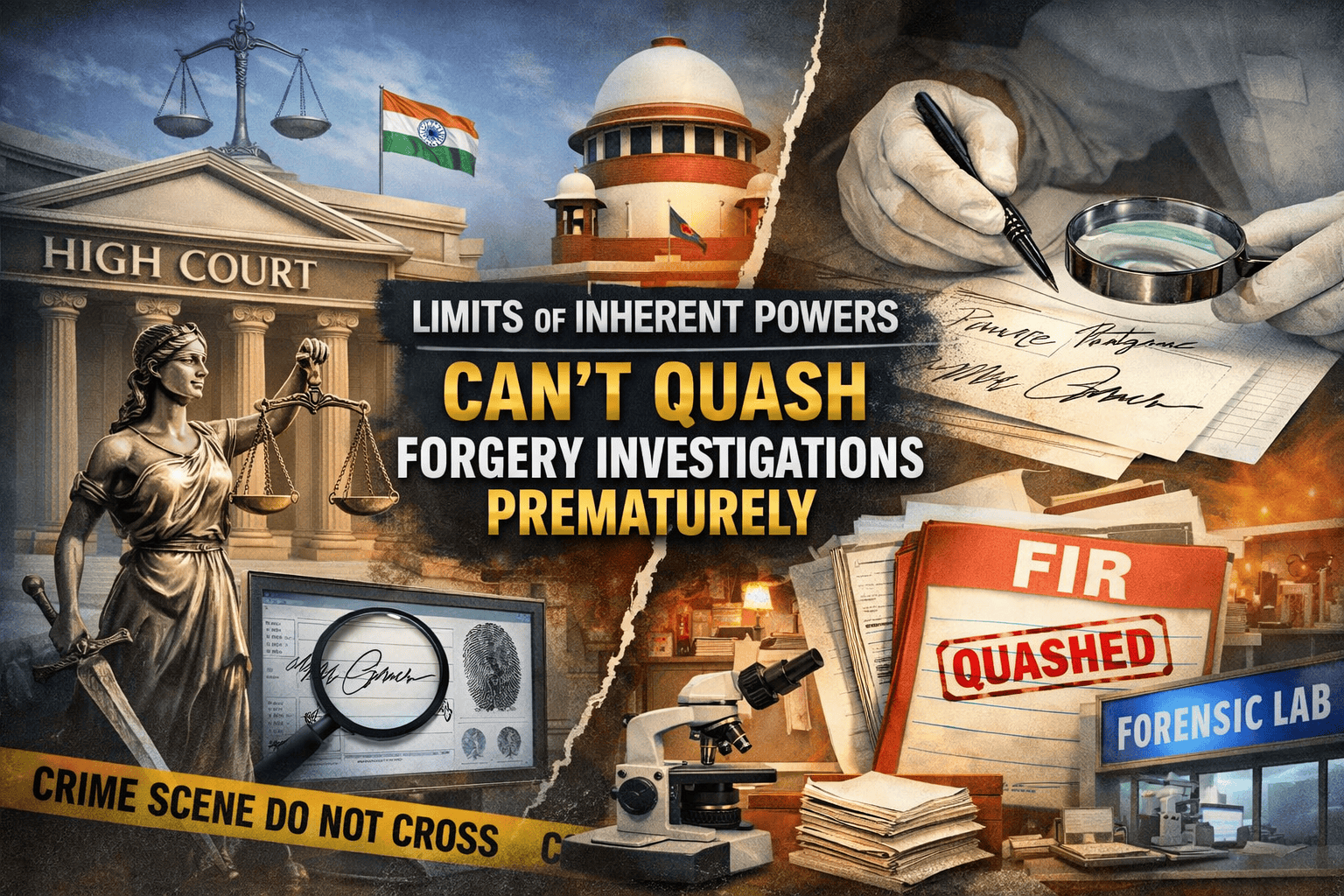
The power to quash criminal proceedings under Section 482 of the Code of Criminal Procedure (now corresponding to Section 528 of the Bharatiya Nagarik Suraksha Sanhita, 2023) is a vital judicial tool designed to prevent the abuse of the legal process and secure the ends of justice. However, this extraordinary and inherent power is circumscribed by strict judicial boundaries. The Supreme Court of India recently reiterated that High Courts must not prematurely stifle criminal investigations, particularly in complex matters of forgery and fraud where forensic and handwriting expert reports are still pending. In the recent landmark judgment of Sharla Bazliel versus Baldev Thakur and others (2026 INSC 252), the Apex Court provided crucial clarity on the premature exercise of inherent powers, reinforcing the fundamental principle that legitimate criminal investigations must be allowed to reach a logical conclusion.
The Factual Matrix of the Dispute
The controversy in the present case stemmed from allegations of a criminal conspiracy to usurp ancestral property and financial assets. The appellant, the adopted daughter and legal heir of the deceased, lodged a First Information Report alleging that the accused persons took advantage of her father's vulnerable mental and physical health following her mother's death. It was alleged that the accused fraudulently isolated him, forged documents to appoint themselves as nominees in his bank accounts, and executed sale deeds for highly valuable family lands at a throwaway price without the mandatory consent of the legal heirs. Furthermore, the property was severely undervalued using forged circle-rate documents, causing a massive loss to the government exchequer.
During the course of the investigation, the Investigating Officer noted grave discrepancies in the documentation and forwarded the questioned documents, including the nominee forms, to the State Forensic Science Laboratory for a handwriting expert's analysis. Despite the fact that the investigation was in full swing and the forensic examination was underway, the accused approached the High Court of Himachal Pradesh seeking the quashing of the FIR. The learned Single Judge of the High Court intervened and quashed the FIR at the very threshold, concluding that the necessary ingredients of fraud and forgery were not made out and that the allegations were merely based on speculation.
The Supreme Court's Emphatic Ruling on Premature Quashing
The Supreme Court fundamentally disagreed with the High Court's approach, setting aside the quashing order. The Division Bench of the Supreme Court categorically held that when specific allegations of forgery are set out in an FIR and the Investigating Agency has actively undertaken the exercise of getting the disputed documents examined by a handwriting expert, quashing the FIR without awaiting the outcome of that expert report is entirely unjustified.
The Apex Court observed that the High Court completely glossed over the vital fact that the investigation into the genuineness of the signatures was actively ongoing at the State Forensic Science Laboratory. By prematurely terminating the proceedings, the High Court effectively stifled a legitimate prosecution. The Supreme Court noted that the proof of forgery in such instances is heavily dependent upon the outcome of the comparison conducted by handwriting experts. Therefore, deciding whether a false document was created or not is impossible while the expert analysis is still pending. Interestingly, the State's subsequent submissions revealed that the forensic report eventually confirmed that the signatures on the questioned documents were indeed fabricated using facsimile stamps, fully vindicating the necessity of a complete investigation.
Broader Legal Context and Relevant Case Laws
This recent pronouncement aligns perfectly with a long line of established judicial precedents that caution High Courts against conducting mini-trials or thwarting investigations at a nascent stage. The foundational principles regarding the exercise of inherent powers were laid down by the Supreme Court in the landmark case of State of Haryana versus Bhajan Lal (1992). In that judgment, the Court established that the power of quashing should be exercised very sparingly and with circumspection, strictly intervening only when the allegations made in the FIR, even if taken at face value and accepted in their entirety, do not prima facie constitute any offence.
Further fortifying this stance, in the case of Neeharika Infrastructure Pvt. Ltd. versus State of Maharashtra (2021), the Supreme Court laid down comprehensive guidelines emphasizing that the police possess a statutory right and duty to investigate cognizable offences. The Court ruled that High Courts should not routinely interfere with investigations unless there is an absolute absence of a cognizable offence or the proceedings are maliciously instituted. Halting an investigation while crucial forensic evidence is being gathered directly contravenes this established legal doctrine.
Additionally, the Supreme Court has consistently held in cases like Central Bureau of Investigation versus Aryan Singh (2023) that at the stage of exercising jurisdiction under Section 482 of the Code of Criminal Procedure, the High Court is not permitted to appreciate evidence or evaluate the reliability of the allegations. The role of the High Court is not to act as a trial court determining guilt or innocence, but merely to ensure that the criminal justice system is not weaponized. In forgery cases specifically, as highlighted in various judgments under the Indian Evidence Act, expert opinion forms a relevant piece of evidence that the trial court must weigh during the trial, not something the High Court should preemptively dismiss or ignore before it is even produced.
Conclusion and Takeaways
The judgment in Sharla Bazliel versus Baldev Thakur serves as a robust reminder of the limitations placed on the inherent powers of the High Court. For legal practitioners and litigants, the takeaway is unequivocal: challenging an FIR for forgery and fraud at the preliminary stage is a highly uphill battle if the investigating authorities are actively gathering technical or forensic evidence. High Courts will not and legally cannot substitute the role of investigating agencies by passing preemptive judgments on the genuineness of documents. Criminal justice mandates that investigations into complex economic offenses and forgeries be given the required time and legal space to unearth the truth, ensuring that the scales of justice remain balanced for both the complainant and the accused.